
AP Bio Score Calculator
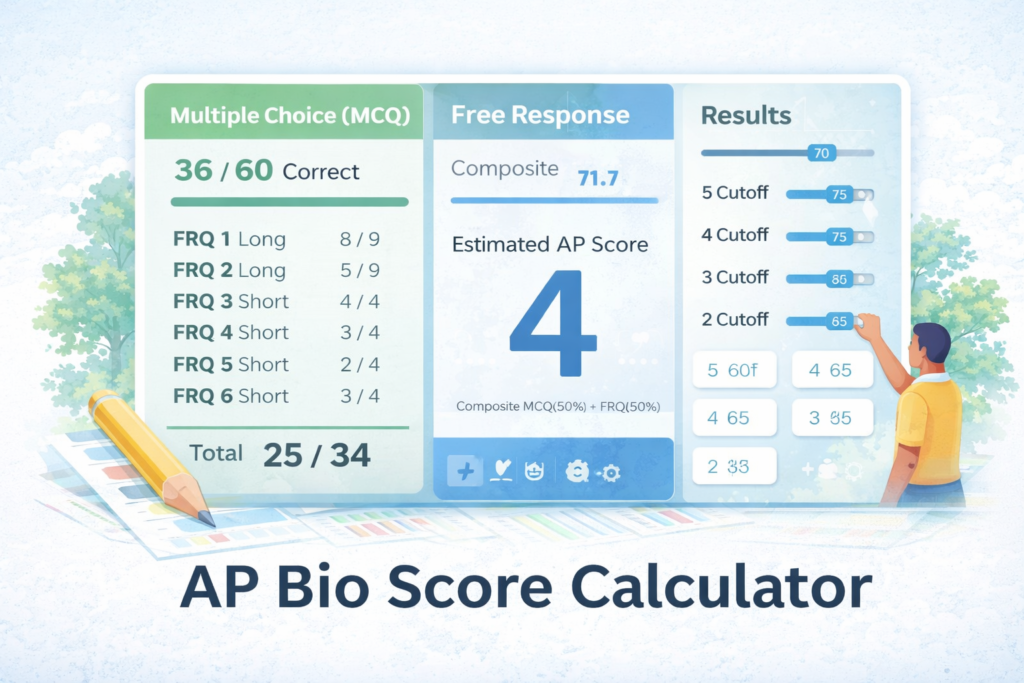
Enter your practice test scores to estimate your predicted AP Biology score (1–5). This calculator uses a weighted composite based on Multiple Choice (50%) and Free Response (50%). Score cutoffs can vary slightly each year.
Multiple Choice Section
Free Response Section
Results
AP Bio Score Calculator
Want to know where you stand before exam day? This AP Bio score calculator estimates your predicted AP Biology score (1–5) using your multiple-choice results and free-response points. It’s designed for practice tests so you can quickly measure progress and adjust your study plan.
How the AP Bio Score Calculator Works
The AP Biology exam has two scored sections: multiple choice and free response. Each section contributes about half of the final score. This calculator converts your raw points into a composite score (0–100) and then estimates a 1–5 score range using adjustable cutoffs.
How to Use This Calculator
- Enter your MCQ correct answers (out of 60).
- Enter your two long FRQ scores (0–9 each).
- Add your short FRQ total (0–16).
- Click Calculate Score to see your composite and estimated AP score.
Tips to Improve Your Score
- Use official rubrics for FRQs so your points are realistic.
- Track your weak units and redo questions after review.
- Practice data analysis and experimental reasoning (FRQs reward clear explanations).
FAQ
Is this AP Bio score calculator exact?
It’s a strong estimate for practice exams. Official score scales vary slightly year to year.
What score is usually considered “good”?
A 3 is typically passing, while 4–5 is strong for many college credit policies (varies by school).
What this calculator does
The AP Biology exam is scored from 1 to 5, and a 3 or higher can earn college credit at many universities. This calculator estimates your AP score from the two sections — multiple-choice and free-response — so you can see how close you are to the next score level and where extra study would pay off most.
How to use it
- Enter how many multiple-choice questions you answered correctly, out of 60.
- Enter your estimated points on the free-response questions, out of 6 questions.
- If unsure of your free-response points, use a practice exam score.
- Read your estimated composite score.
- Read your estimated AP score from 1 to 5, and how many more points you need for the next level.
How it works
The exam has two sections of equal weight. Section I is 60 multiple-choice questions, worth 50 percent. Section II is 6 free-response questions — 2 long and 4 short — also worth 50 percent. Each section is converted to a scaled score, and the two are combined into a composite out of 120. The composite is then converted to the 1 to 5 scale using cutoffs set by the College Board each year, so the exact boundaries shift slightly. As a rough guide, a composite near 100 or above is usually a 5, the low 80s to high 90s a 4, and the low 60s to low 80s a 3 — approximate, not official cutoffs.
Example
Suppose you answer 48 of 60 multiple-choice questions correctly and earn 40 of 60 free-response points. Your composite is roughly 48 + 40 = 88 out of 120. On the rough guide above, 88 usually earns a 4. Raise your free-response score by 10 points and the composite reaches about 98 — close to the range that usually earns a 5. That is why the free-response section, worth half the exam, deserves as much practice as the multiple choice.
Frequently asked questions
What score do I need for college credit? Most colleges give credit for a 3 or higher, but selective universities often require a 4 or 5. Check the policy of your colleges.
Which section matters more? Neither — each is worth 50 percent. Students who focus only on multiple choice often lose most points on the free-response questions.
How accurate is this estimate? It is an estimate. The College Board sets the final cutoffs after the exam and they vary each year, so your real score could be a point higher or lower.